Bathroom renovation: what to decide before the plumber starts
The choices that are cheap on paper and expensive once the walls are closed. Layout, tapware, the shower, and the order the trades work in.
The short answer. Settle the layout and choose every tap, mixer and toilet before the walls are closed. The pipework is set to suit the exact fixtures you’ve picked, and moving it once the tiles are on means pulling them off.
Decide whether anything moves
Keeping the toilet, the shower and the basin where they are is the simplest renovation, because the drains stay put.
Moving them is possible, but the drain under the floor has to move too. In a house on a concrete slab, that means cutting the slab. Under a timber floor there is usually room to work from below.
Tell your plumber what you’d like to move before you order anything.
Choose the fixtures before rough-in
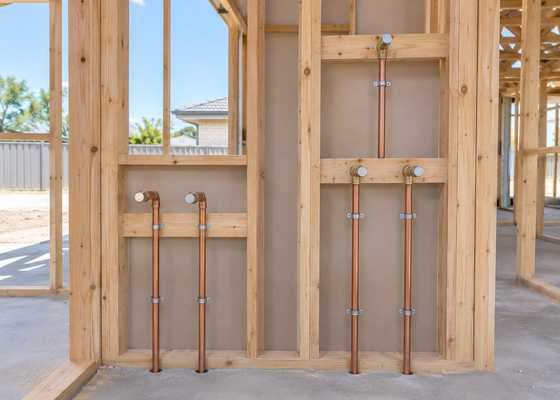
Rough-in is when the new pipework goes into the walls and the floor. Each pipe is left at the position and height that suits one particular fixture, so we need to know what’s going in.
- Wall mixers and wall spouts. The working part sits inside the wall and goes in at rough-in. Only the handle and the plate are fitted at the end.
- The toilet. Toilets differ in how far the waste sits from the wall. An in-wall cistern has to go into the frame before the wall is lined.
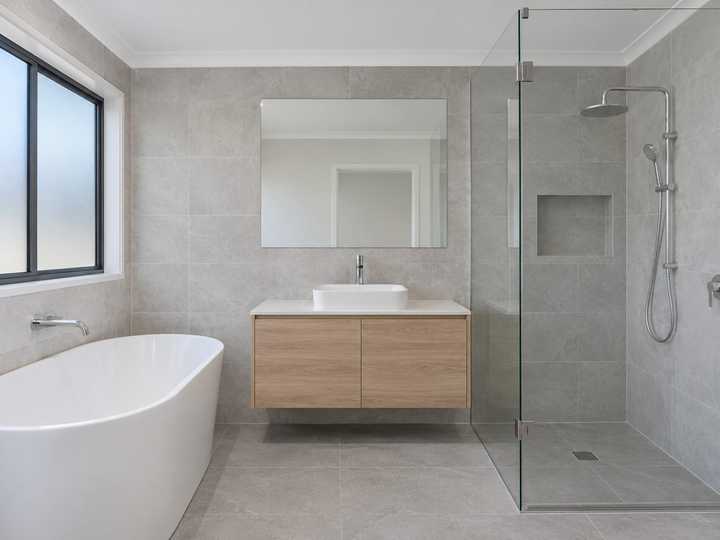
- The bath. A freestanding bath needs its waste in one exact spot in the floor.
- The shower. A rail, an overhead rose or both, and which wall the mixer goes on.
- The vanity. A wall-hung vanity needs its pipes to come out of the wall where the cabinet will hide them.
Have the fixtures chosen, with their installation sheets, before rough-in starts.
Check the water rating
Showers, taps and toilets sold in Australia must carry a WELS water rating label. The more stars, the less water the fixture uses. Bath spouts don’t need a rating, because a bath has to fill quickly.
Ask about hot water temperature
By law, hot water to fixtures used for personal hygiene, such as showers, baths and hand basins, must not be hotter than 50°C. The water is still stored hotter than that to control bacteria, so a tempering valve or a thermostatic tap brings it down on the way to the outlet.
The SA Government notes that systems installed before 1998 are unlikely to have one. If the bathroom is older than that, ask about it before rough-in.
Know the order of the trades
- Strip-out. The old room comes out.
- Rough-in. We move or replace the pipework and the drains to suit the new layout.
- Waterproofing, tiling and cabinetry. The other trades do their part. Under the National Construction Code, wet areas must be waterproofed to AS 3740.
- Fit-off. We come back to fit the bath, basins, toilet, shower and tapware, and test them.
The gap between rough-in and fit-off belongs to the other trades. A change of mind in that gap is the one that costs the most.
What helps us quote
- A sketch or a plan of the new layout.
- A few photos of the bathroom as it is now.
- The fixtures you’ve chosen, or the kind you’re after.
- Whether the house is on a slab or a timber floor.
Call or text Ryan on 0402 133 375, or send the details through.
Sources
- Australian Government, Water rating label. Which products carry a WELS label and what the stars mean.
- SA Government, Hot water safety. The 50°C limit and how it is met.
- Australian Building Codes Board, NCC 2022 Housing Provisions, Part 10.2: Wet area waterproofing. AS 3740.
All read on 16 November 2026.